


How two Bengaluru brothers are building a GitHub alternative for the AI age from Finland
Tangled, founded by Akshay and Anirudh Oppiliappan, is reimagining developer collaboration for a future in which AI agents will increasingly write and review code.

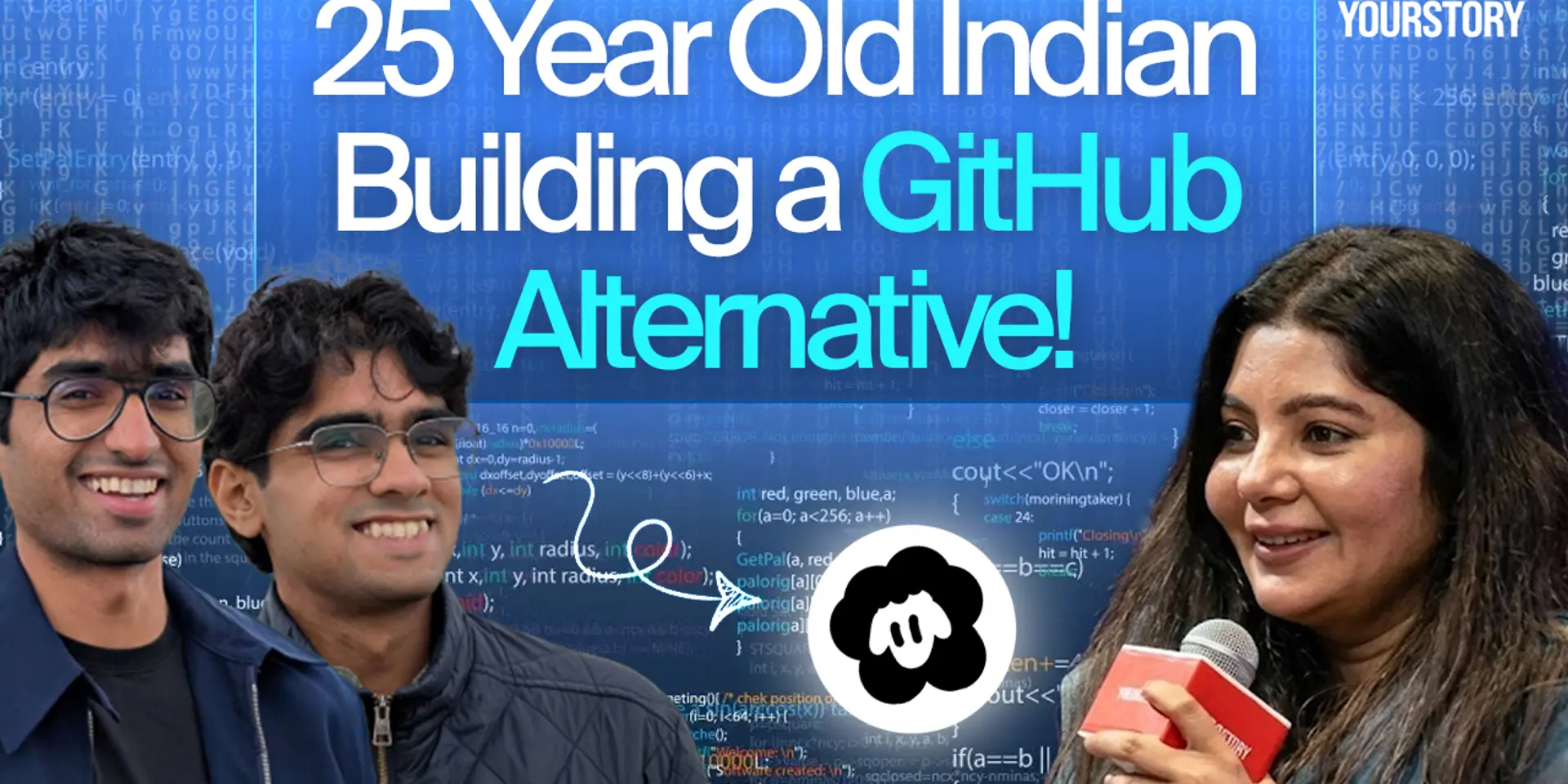

An idea that could potentially disrupt the prominent developer platform GitHub is taking shape in Finland’s capital, Helsinki, helmed by two brothers from Bengaluru.
Akshay and Anirudh Oppiliappan started Tangled about a year ago to ensure that the way developers collaborate on code keeps pace with the growing role of generative AI-based autonomous agents in the process.
“Tangled is our take on the next generation of what social coding or developer collaboration looks like,” CEO Anirudh said in a conversation with Shradha Sharma, founder and CEO of YourStory.
Their venture has already signed up over 8,000 users and nearly 6,000 repositories, entirely organically.
Early last month, Tangled raised about $4.5 million in a seed round, led by byFounders, with participation from Bain Capital Crypto and Antler, and angel investors.
Key to good code
Three years ago, Akshay moved to London to work with a YC-backed startup, while Anirudh went to Helsinki to work for a cloud provider.
Both the Oppiliappans have experience working at developer tooling startups.
“We started Tangled just to solve our own problems with developer tools, and then when we started putting it out, a lot of people sort of reached out and said this is exactly what we want to see from a platform like this,” said Akshay.
At a time when large language models (LLMs) are able to generate code so quickly, he said, the burden is around “reviewing this code and helping build coherent software.”
Therefore, he said, “We are giving developers the tools and the ability to review code much faster and much more efficiently.”
Tangled bases itself on the idea that having a good code review system is fundamentally important to building good software, relevant even in a future where hundreds of LLMs work together with humans in the loop.
Akshay said, “There is value in getting LLMs to review LLM-generated code. But fundamentally, having a human in the loop is almost like how there's a conductor in an orchestra.”
The human in the system is being repositioned rather than replaced.
Alternative to GitHub
At the heart of Tangled’s approach is a rethinking of the code collaboration system popularised by GitHub, which was founded in 2008 and acquired by Microsoft 10 years later.
CEO Anirudh said, “GitHub pioneered the ‘pull request’ (PR) system back when they came out with it somewhere in 2008, and that hasn't really changed ever since. But unfortunately, the ecosystem around it has shifted with AI, and the PR system has proven to be inefficient at reviewing large swathes of code, at least the way GitHub does it.”
An alternative to the GitHub code review system is stacked PRs, which companies such as Google and Meta use.
“In simple terms, it allows developers to stack their changes one on top of another and allows for faster and more efficient code review. And this translates very well into the world of LLMs,” he said, explaining why this has been implemented as a first-party feature in Tangled.
Now, in this early phase of AI, developers use their computers to prompt an agent locally to write code.
The Tangled founders foresee a future when agents operate entirely autonomously, with the humans being “in the loop”, not necessarily at the level of code writing but at a higher architectural level, reviewing changes.
Global outlook
The seed investment will be used to expand the team, said Anirudh, “because we're aiming for a really large problem space here and there's a lot to cover in terms of product roadmap and infrastructure.”
Tangled’s global ambition is reflected in how it operates.
While the company is headquartered in Finland, its footprint spans the UK (Akshay works in London), India, and South Korea, where its engineers are based.
Anirudh said the need to understand computer systems at a fundamental level isn’t going away in an era of agents and coding with LLMs.
That’s because only someone who understands the fundamentals can make high-level decisions to begin with.
“So, I would still say learn to code.”
Edited by Sriram Srinivasan