


Turning factory emissions into supplements: Inside Intrinsic Foundries' carbon-to-value bet
Jharkhand-based Intrinsic Foundries has raised Rs 12 crore led by Transition VC to scale its microalgae-based carbon capture technology for steel, cement, refinery and chemical industries.

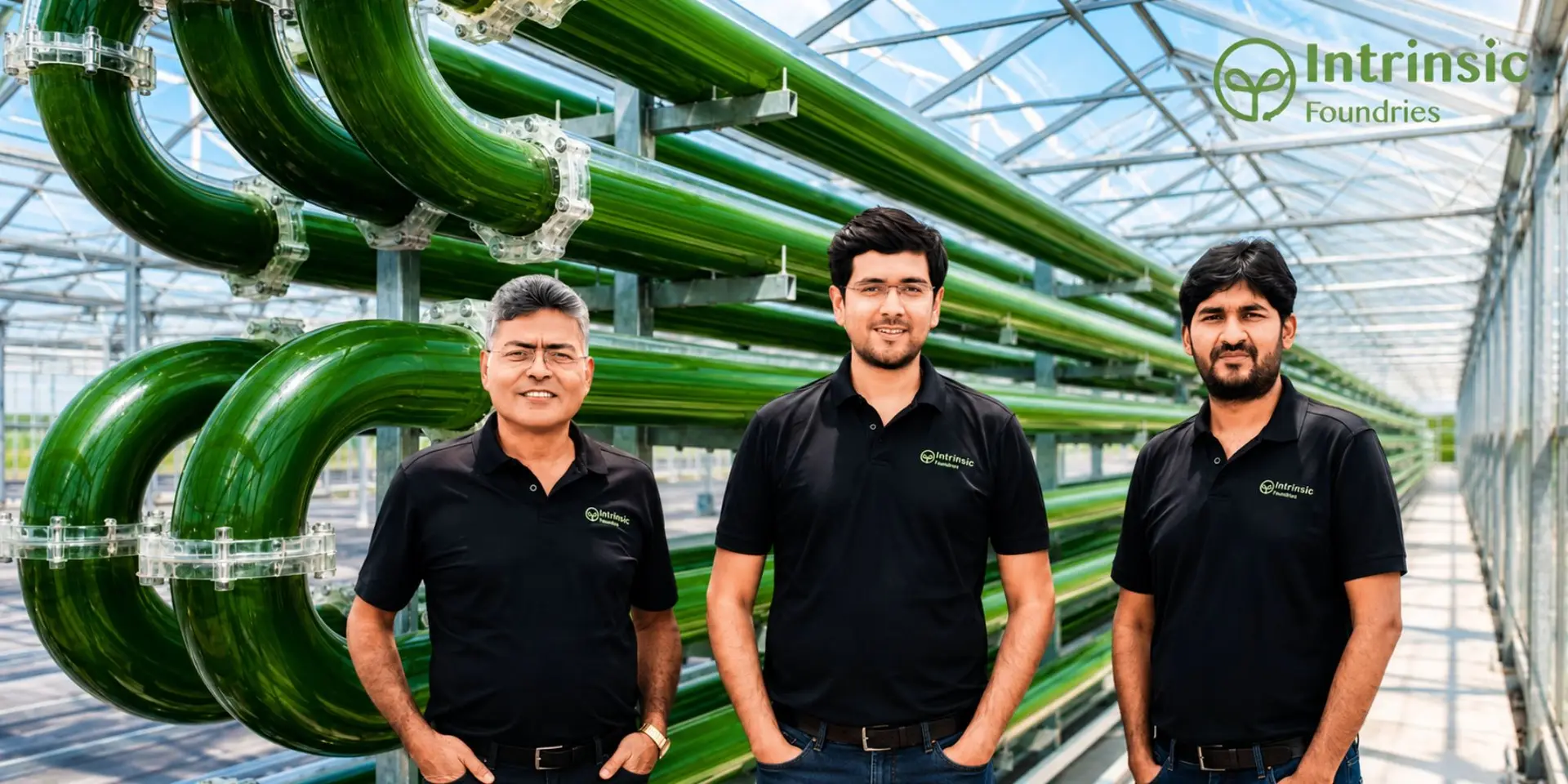

A Jharkhand-based deeptech startup is trying to answer a question that has stumped heavy industry for decades. What if the carbon pouring out of a factory chimney was not waste to be buried, but raw material to be sold? Intrinsic Foundries, a carbon-to-value biomanufacturing company, has raised Rs 12 crore in a seed funding round led by Transition VC, capital it plans to use to take its microalgae-based carbon capture technology from pilot to commercial scale. The round matters because it backs a rare idea in the climate space, one where cutting emissions could actually pay for itself rather than draining balance sheets.
India has committed to reaching net zero by 2070, and the hardest part of that journey lies in the so-called hard-to-abate sectors such as steel, cement, refineries and chemicals. For these industries, carbon capture, utilisation and storage is widely seen as the only realistic lever. The problem has always been money. Traditionally, carbon capture has treated emissions as waste destined for underground storage, often costing tens of millions of dollars, an approach that is capital-heavy and rarely profitable. In its most recent Budget, India committed Rs 20,000 crore over five years to scale up Carbon Capture, Utilisation and Storage, a signal that the policy push is real even as the economics remain stubborn.
How the carbon-to-value biomanufacturing model works
Founded in 2023, Intrinsic Foundries converts industrial emissions, effluents and residues into premium biochemicals using proprietary microbial biorefinery systems, modular photobioreactors and integrated automation. The technology takes a biological route. It feeds captured carbon to microalgae grown inside controlled tanks, paired with what the company describes as Factory 4.0 automation. The microbes consume the carbon and, in turn, produce compounds that can be sold into multiple industries. It is advancing commercial engagement across cement, steel, pharmaceuticals, nutraceuticals and food systems through partnerships with industrial groups. In effect, a steel plant or refinery becomes a supplier of ingredients for the health and wellness shelves.
The startup says it has already moved beyond the whiteboard. In 2025, Intrinsic completed a successful proof of concept at a thermal power plant, demonstrating sustained carbon capture and stable operational performance under real-world conditions. Microalgae is its first focus, while it continues to develop other microbial biorefineries including yeast-based systems.
The roadmap is ambitious. Over the next 12 to 24 months, the company plans to commission multiple industrial pilots and operationalise its first one-tonne-per-day commercial plant. Part of the fresh capital will go towards executing industrial pilots, expanding research, filing IPs, and establishing its US entity to support global market development. Founder Shreyansh Jain, an alumnus of BITS Pilani and Cornell University, frames the opportunity bluntly. "Carbon is not waste. It is a resource waiting to be transformed," he has said. Investors appear to share that read, pointing to weak unit economics and high capital costs as the real barriers that a revenue-generating model could finally clear.
The idea has earned national validation too. The venture, which entered as IIOT Innovation Private Limited, was named among the winners at the National Bio Entrepreneurship Competition (NBEC) 2025, run by the Centre for Cellular and Molecular Platforms (C-CAMP), a Bengaluru-based life sciences research and innovation hub and one of India's largest biotech incubators. NBEC is among the country's most prestigious platforms for deep-science entrepreneurs.
How does a microalgae biorefinery turn smoke into supplements
Microalgae are microscopic, fast-growing organisms that, much like plants, feed on carbon dioxide and sunlight. When industrial flue gas is channelled into a controlled photobioreactor, the algae absorb the carbon as they multiply.
That biomass is then processed to extract specific compounds, the kinds of fatty acids, proteins and pigments that already go into supplements, foods and skincare. Because the algae do the heavy lifting, the system sidesteps some of the energy-intensive chemistry that makes conventional capture so expensive.
The commercial logic is simple. If the end products fetch a premium, the cost of capturing carbon is offset by the value of what comes out the other side, turning an environmental cost centre into a potential profit line.
Whether that promise holds at scale is the open question. Moving from a single proof of concept to a steady one-tonne-a-day plant, and then to volumes that would meaningfully dent India's industrial emissions, is a steep climb on which many climate ventures have stumbled. Yet cross-sector demand for sustainable ingredients is rising, and public funding is flowing towards capture, both of which work in the startup's favour. The next two years, as its pilots either prove or puncture the economics, will show whether factories that pay their own way to cleaner air can move from the lab into the mainstream.