


A stitch-free future for delicate surgery: Shira Medtech takes on preventable amputations
Ahmedabad-based Shira Medtech is developing a low-cost implantable device for sutureless microvascular anastomosis, aiming to make complex reconstructive surgery faster, safer and more accessible.

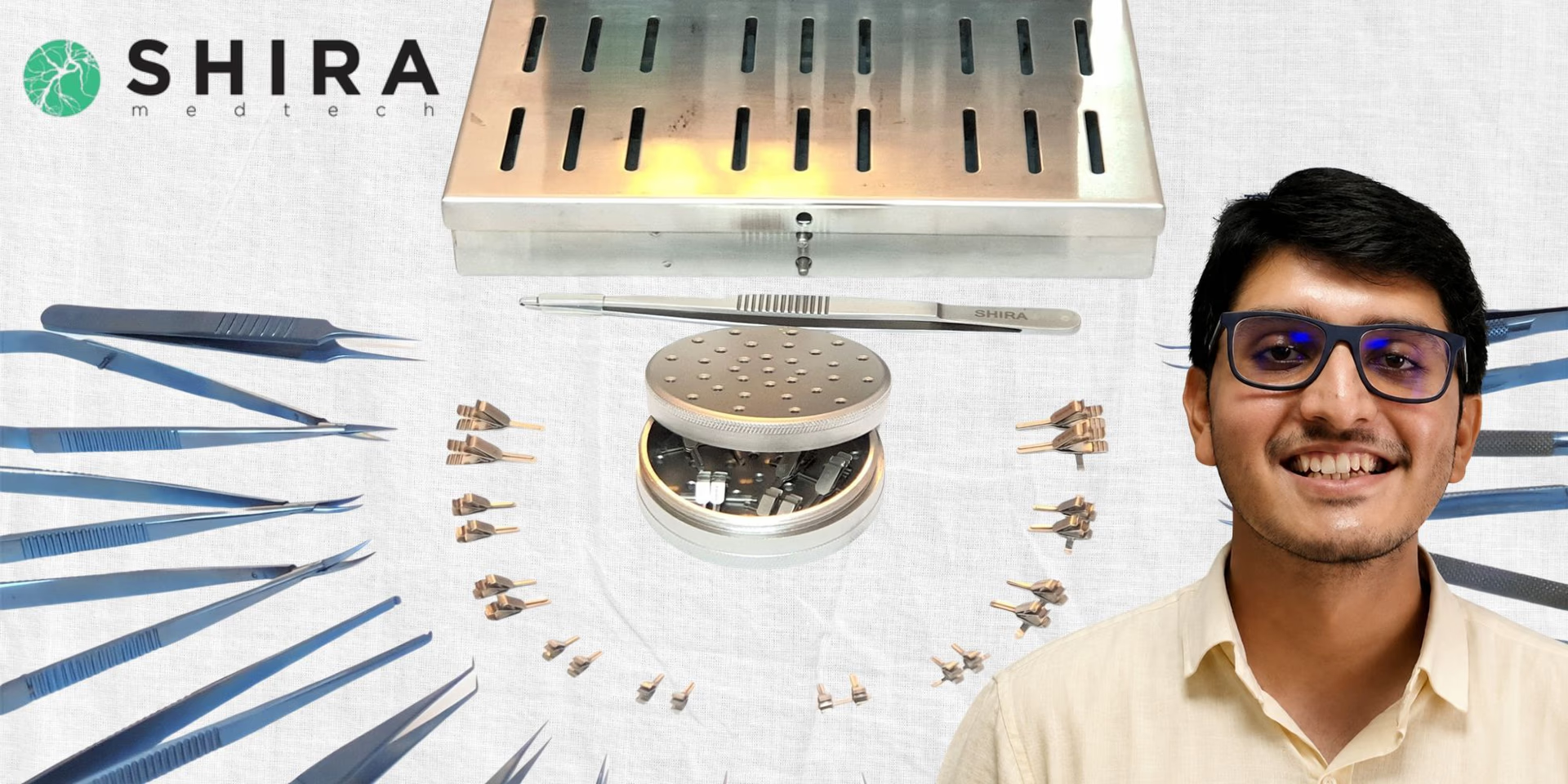

Joining two blood vessels thinner than a strand of spaghetti is one of the most demanding tasks in surgery, and the shortage of surgeons who can do it well has real human costs. Shira Medtech, an Ahmedabad-based medical device startup, is working to change that with a low-cost, high-precision implantable device designed to enable sutureless microvascular anastomosis, the faster and safer joining of tiny blood vessels. The goal is significant because it could widen access to reconstructive surgery in resource-limited settings and help prevent amputations that better surgical tools might otherwise avert.
The difficulty is structural. Microvascular surgery is a highly complicated procedure in which the two ends of a blood vessel are reattached to restore circulation, there are very few specialists trained in the field, and many junior doctors drop out because of the steep learning curve. The stakes are high in a country where, by one earlier estimate, around 12 million people are living with physical disabilities, many of them following amputations. Shira Medtech has been chipping away at this problem for years. Founded in 2016 by Anand Parikh, a graduate of IIT-Madras, the company built the Shira Clamp, which has been in use by surgeons since 2018.
Building on a proven clamp towards a sutureless device
The flagship product set the foundation. The Shira Microvascular Clamp is an indigenously developed and patented device that simplifies microvascular anastomosis, enabling less experienced surgeons to perform a specialised surgery safely and serve patients of cancer surgery and preventable amputations. The thumbnail-sized device holds the vessel ends open and gives surgeons clear visual access to the suture site while reducing tissue manipulation, making the procedure easier, faster and more dependable than the traditional technique.
The newer ambition goes a step further, removing stitches from the equation altogether. The company has been developing products that can eliminate sutures, and the device now in focus is positioned as a low-cost, implantable solution for sutureless anastomosis. The appeal is intuitive. Hand-suturing vessels under a microscope is slow and unforgiving, so a reliable sutureless approach could cut operating time, reduce the skill barrier and improve outcomes, particularly in smaller hospitals that lack super-specialists.
Credibility for the venture is not in short supply. Shira Medtech has won recognition from the Government of India, the Department of Biotechnology, the Department of Science and Technology, the Government of Gujarat, Tata Trusts, Lockheed Martin and Titan Company. It has also been backed by the BIRAC Biotechnology Ignition incubator and was awarded the Gandhian Young Technological Innovation Award. That recognition has continued recently. The idea was named among the winners at the National Bio Entrepreneurship Competition (NBEC) 2025, run by the Centre for Cellular and Molecular Platforms (C-CAMP), a Bengaluru-based life sciences research and innovation hub and one of India's largest biotech incubators, among the country's most prestigious platforms for deep-science entrepreneurs. Its clinical work has been documented in peer-reviewed surgical literature, and its reach is now crossing borders, with products that have received MDA approval and are available in Malaysia through an exclusive distribution partner.
What is microvascular anastomosis, and why is it so hard
Anastomosis simply means surgically connecting two structures. In microvascular surgery, those structures are blood vessels often less than two millimetres across, reconnected so that blood can flow again after trauma, cancer removal or reconstruction.
The difficulty lies in the scale. A surgeon places a series of impossibly fine stitches around the rim of each vessel while peering through a microscope, with little margin for error. A clumsy join can clot or leak, undoing the entire operation and, in the worst cases, costing a patient their limb.
That is why tools matter so much here. Anything that holds the vessels steady, keeps them open or removes the need for stitches lowers the chance of failure and shortens a procedure that can otherwise run for hours.
The forward path for Shira Medtech runs through validation and access. A sutureless device that performs reliably in everyday operating theatres, not just in expert hands, could meaningfully expand who gets reconstructive surgery and where. With a track record of adoption, awards and an early international footprint behind it, the company is betting that the next leap in this field will be about removing complexity rather than adding it, putting advanced surgery within reach of the many hospitals that have long been priced or skilled out of it.