


WPL team UP Warriorz is just the beginning of Jinisha Sharma’s bigger play in women’s sport
Jinisha Sharma, Director of Capri Sports that owns the UP Warriorz franchise in the Women’s Premier League, talks about her bets on the WPL team and building a true multi-sport ecosystem in the country.



It’s the day after UP Warriorz’s first win in the Women’s Premier League (WPL) this year, against Mumbai Indians, and Jinisha Sharma can’t contain her excitement.
Jinisha is the director of Capri Sports, which owns the UP Warriorz WPL franchise.
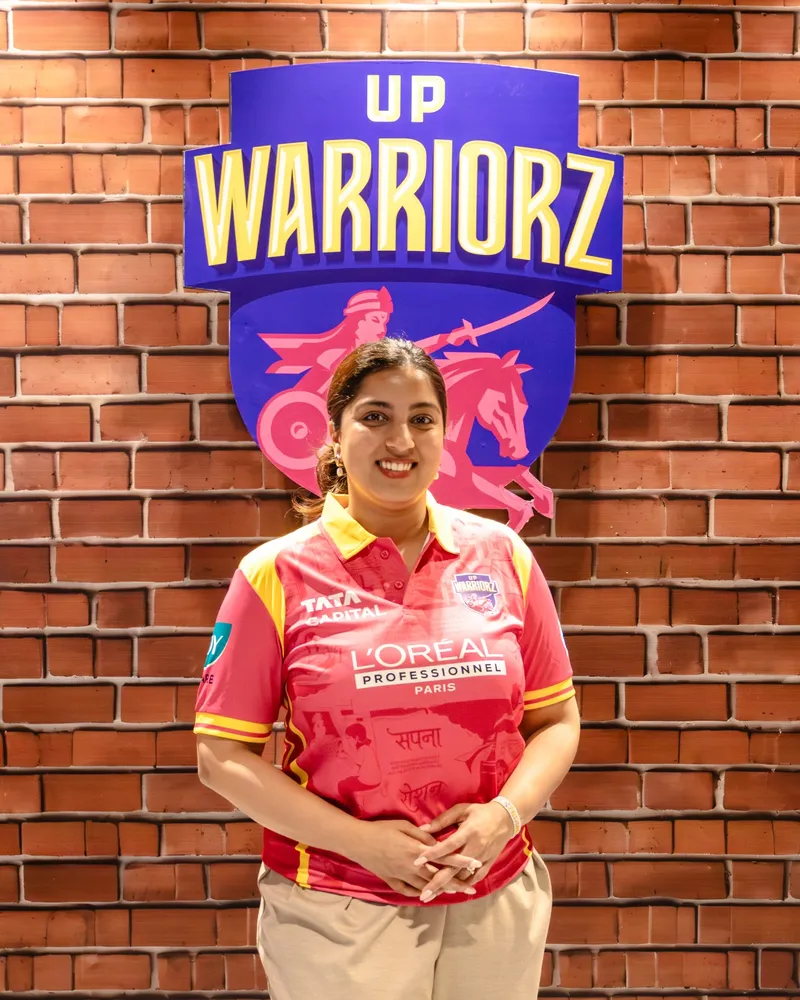
Celebrating every win, big or small, validates the company’s carefully thought-out decision to back a franchise from Uttar Pradesh.
“We represent a progressive idea of UP: women’s cricket at an elite, commercially viable level, in a state where there is still a lot of ground to cover. We want to be part of that journey of change,” says Jinisha.
And there are already signs of change on the ground.
“Families are increasingly supportive of their daughters’ aspirations, and sport is emerging as a powerful pathway. We aim to create more opportunities for girls to participate and move up the ranks,” says Jinisha, who manages UP Warriorz and other Capri-owned sports holdings and also leads grassroots and community-building initiatives beyond the WPL calendar.
Capri Sports is the sports division of Capri Global Capital, an NBFC built by her father Rajesh Sharma as a first-generation entrepreneur. “I’ve always admired the path he laid out, and I’ve learned a lot from him growing up,” says Jinisha .
She is now charting her own journey as she leads the UP Warriorz franchise with the larger vision of investing in women’s cricket and creating purpose-led impact through sport.
Sport has been a constant presence in her life. At school, she was involved in multiple disciplines—football, basketball and cricket. “It was one of the ways I expressed myself outside the classroom,” she says.
After completing graduate school, Jinisha joined Capri Loans, a group company. But sports was always going to be her calling, some way or the other.
After a sabbatical for her master’s degree at Exeter University, UK, Jinisha returned to the company at the end of 2022 when it was exploring new avenues for growth, including sports.
Capri Sports presented the perfect opportunity for her to rekindle her interest in sports, albeit in a different avatar.
In a single year (2023), under Jinisha’s leadership, Capri invested in four sporting teams: UP Warriorz (WPL), Bengal Warriors (Pro Kabaddi League), Rajasthan Warriors (Ultimate Kho-Kho), and Sharjah Warriors (International League T20 cricket).
In an interview with HerStory, Jinisha speaks of her role in Capri Sports, her bets on UP Warriorz, and her biggest learnings from her stint. She also talks about the increasing interest in women’s cricket among brands and the emergence of women’s sports beyond cricket.
Edited excerpts:
HerStory (HS): What drew you personally to WPL? Why did you feel it was the right space to invest your time, conviction, and money?
Jinisha Sharma (JS): Having studied abroad, I experienced the growth of women’s sports before it made its way to India. Exeter University had a very strong sports culture and it was eye-opening to see how multiple sports, including women’s sports, thrive.
When the opportunity to invest in the WPL came along, I was keen to see whether it could cultivate an entirely new audience beyond those already watching cricket. One that is next-generation, female-forward, and family-forward, drawn to women’s sport because it represents something more. That’s the kind of hero-building I want to support.
There were several factors: investment perspective, and what this would do for Indian sports and women's sports. It checked multiple boxes, and I decided WPL should absolutely be in our sports portfolio.
HS: How intentional was the choice for Mumbai-based Capri Sports to root the franchise in Uttar Pradesh?
JS: We chose UP very deliberately. It’s the largest and most populous state, with significant long-term
commercial potential. From a fan-base perspective too, we felt sport could penetrate the state in a very different way. There was clearly a commercial lens to the decision but also a larger ambition.
At the same time, we are aware that we represent a progressive idea of UP: women’s cricket at an elite, commercially viable level, in a state where there is still much ground to cover. We want to be part of that journey of change.
What is encouraging is what we’re seeing on the ground. Families are increasingly supportive of their daughters’ aspirations, and sport is emerging as a powerful pathway. Our aim is to create more opportunities for girls to participate and move up the ranks.
Players like Deepti Sharma embody this shift. Having spent time with her family in Agra over the years, it’s clear she grew up with unwavering support. Through our initiatives, we are seeing more families like hers.
We’re also working at key intersections—sport with life skills, education, and health—identifying gaps and trying to close them.
For instance, we have worked with athletes and coaches in state government academies to address conversations around periods, which still remain taboo but directly impact performance.
Through school programmes across 11 cities (in UP), college-level women’s tournaments in Lucknow, and partnerships like the one with ITC, we have seen strong participation and infrastructure. What’s needed now are the right programmes delivered in ways that build confidence and keep girls in the game.
HS: With four seasons in, what have been the biggest learnings from building a team like UP Warriorz?
JS: On the cricketing side, one key learning was the need to strengthen our domestic bench and not rely too heavily on overseas players. Having Indian coaches was always a priority. While overseas coaches have been fantastic, their availability is limited. This year, everything aligned—Abhishek (Nayar) was available, he had already been supporting us during off-season camps, and it was also a mega auction year when we were reassessing our approach after inconsistent performances. Bringing him on officially (as the head coach) made sense.
It has helped players feel more comfortable and has contributed to building the right culture within the team.
Off the field, the intentional brand-building work we started early on is beginning to show results. Grassroots and community-building have often been taken for granted by legacy sports brands, and we saw that as an opportunity. Learning from global sports—especially football clubs with decades of community engagement—we wanted to build something similar with UP Warriorz, and it’s starting to resonate.
Sponsors have noticed this intent. A month-long tournament like the WPL isn’t enough on its own; brands need year-round engagement. Our learning has been that to attract the right partners, we need to offer longevity and alignment beyond match days. The groundwork we’ve been laying over the last few years is now paying off.
Perhaps the biggest lesson has been patience. We realised we don’t need to do everything at once. By pacing ourselves and focusing on foundations, the impact becomes more meaningful and sustainable over time.
HS: OpenAI has come on board as a premier partner of the WPL this year. How do you see conversations around sponsorship changing for women's cricket and specifically for WPL in the long run?
JS: Big names coming in was an expectation we all had after the World Cup. A historic win like a World Cup and the WPL happening within months of each other was a unique opportunity.
The brands that have come on board have understood what this opportunity means. OpenAI, and, for us, L'Oréal, a global beauty brand, coming in, is a huge statement about how they want to walk the talk.
Going forward, the sponsorship market as a whole will start to evolve because we are going super digital-heavy.
WPL is hopefully going to start looking at bigger opportunities like co-packaging of products, co-branded products, and licensing deals that I hope we move towards so new revenue streams can start opening up beyond where we are right now.
HS: How different is your experience at Capri Sports compared to your earlier stint in the larger Capri group?
JS: Sport is one thing where you can do everything right—get the best players, the best coaches, do everything right—but you can't will the outcome.
That has been a very humbling experience. You need to know when to let go. In other parts of the business, you are much closer to what the outcome will be. If you are looking to increase cost efficiency or start a new vertical, that decision is in your control.
HS: You sit at the intersection of finance, sports, and, most importantly, gender equity. How do you see Capri Sports evolving in the bigger picture of women's sports?
JS: From what we have seen with the WPL, there’s a clear opportunity to grow women’s sport beyond cricket as well. One of the missing links has been the lack of pathways for new audiences to discover and follow women’s sport. To build that engagement, we need more commercially structured leagues like the WPL across other sports, so audiences can grow alongside the game.
The challenge, of course, is the familiar chicken-and-egg situation. Do we have enough teams and depth to justify commercial investment, or does investment need to come first to build that depth? It’s a delicate balance, but one that requires intentional structuring of leagues, teams, and clubs to create momentum.
Women’s football is a key focus area for us. We have already begun our journey through a grassroots club in Mumbai, with the aim of understanding the ecosystem end-to-end—where the gaps are, what challenges players face, and how systems can be strengthened. Over the past two years, that work has given us valuable insights.
This year, our focus is on scaling our efforts in women’s football. It’s a sport with immense potential, and we’re approaching it with a long-term lens; a 10-year vision of being an active contributor to the growth of the game and, ultimately, to strengthening pathways toward international qualification.
HS: A decade from now, when you look back, what would make you say, “We built this right”?
JS: Ten years from now, I would consider Capri Sports successful if we have helped build a true multi-sport ecosystem. Not just in terms of commercial returns on our portfolio, but also in the value we have added to the larger sporting landscape by doing meaningful work that isn’t simply replicating what already exists.
We benchmark ourselves only against ourselves. The question we keep asking is whether every rupee we invest is driving growth, expansion, and new sporting experiences that enrich audiences and contribute to where Indian sport is headed overall. It’s never been just about revenue.
If we can look back and say we genuinely added value, and were the changemakers we set out to be, then we will know we have done our job.
Edited by Swetha Kannan