


From an idea to market launch: The journey of Anabio Tech’s flushable pad
Anabio Tech, a deep tech startup founded by Mithun Shah, is all set to launch a flushable sanitary pad made from plant-based, biodegradable materials.


The boardroom at YourStory's office has seen multiple founders passionately pitch their products, accompanied by demos and decks. But this one, way back in 2018, was different.
Mithun Shah, a materials scientist, had given up a senior role in corporate America and moved with his family to Bengaluru, a city where he knew no one, to bring to life a solution he had already created.
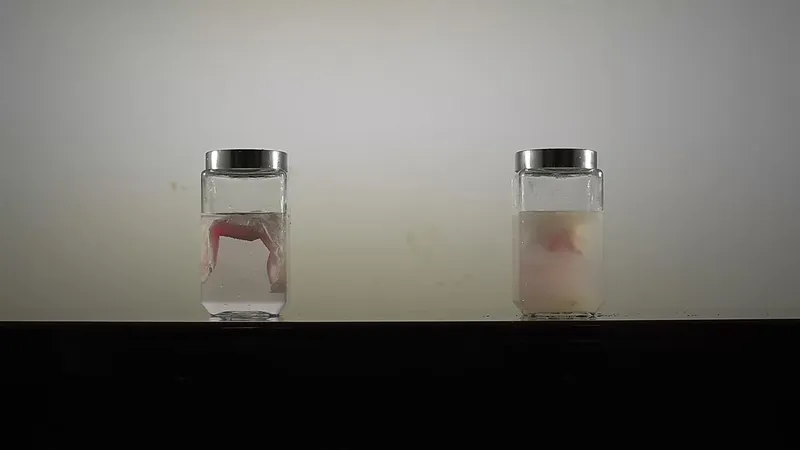
How the flushable sanitary disintegrates and dissolves (right)
He took out a sanitary pad and dunked it into a bottle of water. He shook the bottle vigorously, and the pad began to disintegrate and dissolve. The room watched in awe, and at the end of the demonstration, everyone huddled there became his first backers.
“I recall each one present there put in Rs 100, one even gave me Rs 500. I wrote down their names. They are all getting a good deal,” Shah laughs.
Eight years later, Shah's deeptech startup, Anabio Tech, is all set for the commercial launch of a flushable sanitary pad made from plant-based, biodegradable materials.
The long way
Shah grew up in Coimbatore in a family rooted in the textile industry. After completing his textile engineering degree, he joined his father for about six months and quickly realised he wasn’t cut out for the job.
“The market was heavily commoditised, and no matter how much effort you put in, it was too competitive, and there was too much risk for too little return,” he admits.
But Shah was always sure of one thing: he wanted to build products and in his own company, as an entrepreneur. And, the only way to build something meaningful was to go the technology route.
He moved to the US to pursue a master’s in Materials Science and Textiles at the University of Massachusetts and worked nonstop in the lab for three years in a rigorous programme, where he admits he “didn’t almost make it.”
Now that he had learned to think like a scientist, the grand plan was to gain industry experience in technology and corporate America, and then build something of his own.
He started as a scientist at a large multinational organisation in their medical business, designing surgical fabrics and eventually headed the R&D division, staying there for 12 years.
“In parallel, I kept trying different ideas and ventures, and I kept failing. Every time I failed, I learned something. The ideas kept getting more refined and real,” he says. He tried his hand in the medical device business and also ventured into large-scale solar farms. But they all failed.
The idea arrived, as many do, during a conversation. It was June 2017. A friend from Harvard Business School called Shah and asked him to look into the sanitary pad market in India — an investor had noticed that penetration was low and growth was high. When Shah started digging, it led him to the white space: at the time, only 40% of women in India used pads, and 60% did not. Demand wasn't the problem.
But making pads like everyone else held no interest. He could have done that 15 years ago in his father's business. So he started asking a different question: what hasn't the industry solved?
His wife gave him the answer. She said what millions of women have thought, but nobody in the industry has heard: "I hate disposing of a pad. I can't stomach the footprint it leaves on the planet. If there's something we can solve, we should solve that."
"I had my first customer sitting right there. And I didn't have to fight the idea at home. That's a good start,” Shah says.
He began approaching the idea clinically, as his training had taught him. He started researching and building prototypes in his garage, and by November-December 2017, as a scientist, he was convinced that it was possible in principle. But what was also important was: did people actually want it?
He hired an independent third-party research firm to conduct studies with over 200 women on menstrual health and hygiene. They got the feedback they expected: everyone wanted a better pad, a softer and larger pad, but not one person spontaneously touched upon disposability as a problem.
“But we anticipated that. So we planted the question at the end: “What if we gave you a product you could flush and never have to deal with disposal again? There was near disbelief among nearly every respondent. And then 85% said they would want to switch to a flushable option,” Shah explains.
The industry has done a remarkable job improving comfort and access — from reusable cloth to the first pads without wings, then with wings, then ultra-thin options. But not one organisation has solved for what happens after use.
The family then moved to Bengaluru, and Anabio was officially incorporated in September 2018. It is located in Electronic City, Bengaluru.
The science behind the flushable pad
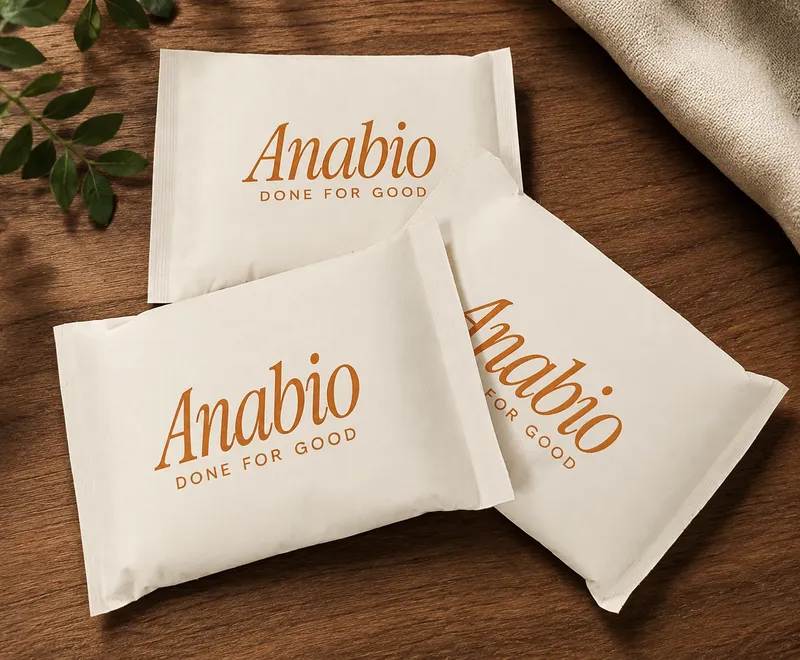
The Anabio flushable sanitary pad
The fully flushable, disposable sanitary pad is a highly-engineered product manufactured in Europe because, as Shah points out, precision manufacturing at this level requires European infrastructure.
“We have built every single layer from scratch. Every top sheet, bottom layer, absorbent core — all of it is our own engineering. We then go to factories across Europe, rent machine time, provide them with our exact conditions, and produce each layer. We work across multiple countries to bring the final product together,” he explains.
During the Covid-19 pandemic, when he couldn’t travel to Europe, he built a second line of business in life sciences, working on antiviral treatments. The business, Shah says, is earning multiple millions in revenue and generating profits, which are reinvested in the flushable pad project.
Anabio Tech has earned the support of Startup Karnataka and the Biotechnology Industry Research Assistance Council (BIRAC). Two patents have been filed, with one already approved.
The company has been conducting consumer studies for the past five years, beginning with small cohorts of 50–100 participants and expanding significantly over the last year to include more than 2,000 users across India. The response has been encouraging, with 81% of users willing to switch to the product even in its current version.
To ensure performance across the country’s diverse sanitation infrastructure, the pads were tested in hundreds of toilet configurations and by consumers across 500–600 pin codes nationwide. In the majority of cases, it flushed in a single flush. Around 60% of pads flushed in a single attempt, 90% within two flushes, and 97–98% within three. While a small number of cases faced challenges due to low water pressure, the overall performance has exceeded expectations.
Anabio Tech has also been working with the Bureau of Indian Standards (BIS) for a year, not just on its own product, but as a participant helping to build flushability standards.
Shah's journey has been marked by setbacks as much as breakthroughs. Beyond failed startup ventures and thousands of product iterations, he faced one of his biggest challenges in January 2025, when a fire destroyed Anabio Tech's laboratory, wiping out equipment and years of research and development work. Yet the team rebuilt and continued to pursue its vision.
“We feel it's a miracle that we are still here. And we are genuinely blessed to be where we are,” he says.
The startup's innovation has garnered significant attention. In 2024, Anabio Tech was named Startup of the Year at the Bangalore Tech Summit. This year, it was featured among Chiratae Ventures' Sonic Deeptech Disruptors, a list spotlighting promising startups pushing the boundaries of deep technology.
“Our prediction is that in the next 10 years, every sanitary pad and diaper will be flushable. The next wave is flushability becoming the default. We want more companies in this space, because Anabio alone cannot move an entire industry. But whoever enters this market, the standards have to be right,” concludes Shah.
(The story has been updated to include Startup Karnataka)
Edited by Affirunisa Kankudti